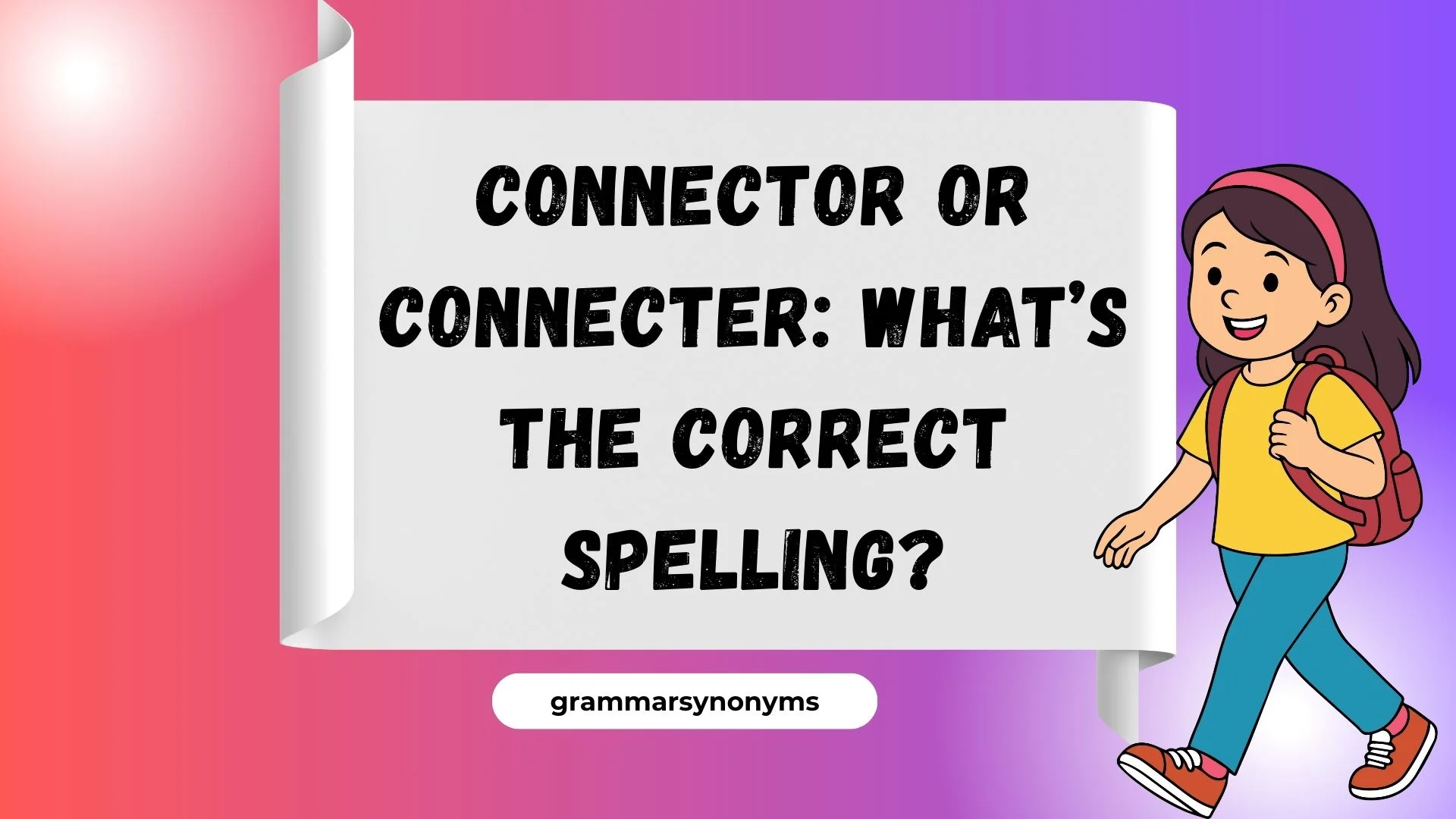
Have you ever paused mid-email and wondered whether Connector or Connecter is the correct spelling? You’re not alone—especially when you’re trying to Have Fun with words while keeping your business communication, scheduling, and project management notes polished and professional. In a world full of meetings, calendars, online booking, and nonstop broadcasting, even one small spelling choice can affect the clarity and consistency of your message. That’s why understanding the correct form matters in English usage, grammar, and formal writing.
In this article, you’ll learn the precise difference between “connector” and “connecter,” why one version dominates modern writing, and how US vs. UK style guides shape spelling preferences. You’ll also see how choosing the right form helps maintain consistency across professional documents, whether you’re drafting instructions, writing emails, or updating your company’s communication templates.
By the end, you’ll know exactly which spelling to use—and why it matters for both readability and real-world communication.
Why this matters: clarity, credibility, and searchability
Spelling affects more than one word on a page. It shapes how readers judge the writer. It also affects how machines index and retrieve content. Correct spelling builds trust. It makes instructions safer in technical contexts. It keeps patents and legal documents precise. When you publish, post, or print, pick the standard form so readers understand you meant business.
Connector or Connecter — the definitive answer
Connector is the correct spelling in standard English.
Dictionaries list connector as the established form. Reputable technical standards, electronics catalogs, and style guides use connector. The variant connecter appears rarely, often in informal texts or in error, but it does not have wide acceptance in dictionaries or style manuals.
Quick proof points
- Major dictionaries such as Merriam-Webster and Oxford list connector not connecter. (See Merriam-Webster: connector; Oxford/Lexico: connector.)
- Technical industries from electronics to plumbing use connector in product names and specifications.
- Engineering standards and datasheets consistently use connector for parts and devices that join circuits or cables.
What does “connector” mean? (and why spelling matters)
Connector refers to anything that links, joins, or couples two things. It appears in multiple fields.
Common contexts
- Electronics and hardware: a USB connector, an HDMI connector, a connector pin. These are physical parts that join circuits.
- Plumbing and mechanical: pipe connectors, hose connectors.
- Grammar and rhetoric: connectors are words or phrases that link clauses, sentences, or ideas. Examples include however, therefore, and, as a result.
- Computing and software: database connectors, API connectors, middleware that links systems.
- Social and conceptual: connectors can describe people who link groups or networks.
When you use the word in a technical manual the right spelling avoids confusion. When you use it in writing about grammar it clarifies function. When you use it in SEO the correct term improves discoverability.
Why “-or” not “-er”? A simple morphology lesson
English forms agent and instrument nouns using different suffixes. Both -er and -or appear. Which one fits depends on history and Latin influence.
Core idea: many formal nouns that denote a role or instrument come from Latin and use -or. Words like actor, editor, factor, conductor follow that pattern. Connector aligns with that pattern.
Why people use -er
- Many English nouns are formed with -er too, especially Germanic-origin verbs turned into nouns like writer, dancer, runner.
- Because -er is common native English, writers sometimes guess connecter and that guess looks plausible.
Why -or is correct here
- Connect comes from Latin connectere and the noun form historically follows the -or instrument pattern.
- Over time English settled on connector for devices and roles that perform the action of connecting.
Rule of thumb: for words that resemble Latinate verbs or technical devices prefer -or when a standard form exists. If a dictionary lists only one form follow it.
Usage examples and corrected sentences
People often mix the forms. Below are common sentences and the correct version.
Incorrect: Plug the connecter into the port.
Correct: Plug the connector into the port.
Incorrect: The connecter failed after repeated use.
Correct: The connector failed after repeated use.
Incorrect: Use a DB9 connecter for legacy systems.
Correct: Use a DB9 connector for legacy systems.
Grammar use example:
Correct: Transitional connectors such as however and therefore improve flow.
Connector vs Connecter across English varieties
Some spelling differences exist between British and American English. Connector remains standard in both.
What to expect
- Both British and American dictionaries list connector.
- Technical catalogs and standards in the UK and US use connector consistently.
- Connecter has no recognized regional advantage.
Practical take: Pick connector no matter which English variety you write in.
Common mistakes and why they happen
People choose connecter out of habit or analogy. Here are typical reasons.
Why writers use connecter
- Analogy to writer, runner, designer where -er is common.
- Influence of spoken English where vowels swap and exact endings blur.
- Typing errors that never get caught by spellcheck if a writer uses nonstandard dictionaries.
- Non-native speakers whose language patterns favor -er endings.
Mistake consequences
- A technical manual with inconsistent spelling can confuse technicians.
- Peer reviewers and editors may mark work as careless.
How to remember the correct spelling: practical mnemonics
These are quick memory aids you can use.
Mnemonic 1 — Think “actor” not “baker.”
Connector sounds like actor because both use -or for a role or device.
Mnemonic 2 — Picture the plug.
Visualize a USB plug and mentally attach the label connector. Images stick.
Mnemonic 3 — “-or” for instruments.”
If it’s a tool or device that performs a job use -or. This fits connector.
Mnemonic 4 — Sound check.
Say the word slowly. The ending that sounds like -or is what you write.
Practical guide: when to use connector in your documents
Follow this checklist when you write.
If the item is a device or part
- Use connector. Example: coaxial connector, cable connector.
If the item is a software bridge or adapter
- Use connector. Example: API connector, database connector.
If you mean a linking word
- Use connector. Example: discourse connectors.
If in doubt
- Open a trusted dictionary and search connector.
- Use a style guide on technical terms for your field.
Table: Connector usage across fields
| Field | Typical phrase | Correct example |
| Electronics | physical joining device | HDMI connector |
| Plumbing | mechanical coupling | pipe connector |
| Computing | software/adapter | Salesforce connector |
| Grammar | linking words | discourse connector |
| Networking | cable interface | RJ45 connector |
| Automotive | harness and pins | wire-to-wire connecto |
Connector types quick reference
Common connector families and where they appear
- USB (Type-A, Type-C): computers, chargers
- HDMI: AV devices, TVs, monitors
- RJ45: Ethernet networking
- BNC: broadcast and test equipment
- DB-series (DB9): legacy serial connections
- Molex: PC power and internal wiring
- Coaxial F-type: cable TV and satellite
- Barrel connectors: DC power jacks
- PCB headers and pins: circuit boards
- SMA/SMB: RF and antenna connectors
This list is not exhaustive. It shows how central connectors are to hardware design.
Case study: a product manual that used “connecter” (and how it was fixed)
Situation: A mid-sized company published a user manual for an audio mixing console. The manual repeatedly used connecter. Customers emailed about confusion. Search engines ranked the manual lower for queries on connector pinouts.
Problems caused
- Users mis-typed searches and found fewer resources.
- Technical support fielded repeated clarifying questions.
- The perceived quality of the manual suffered.
Fix
- Replace all instances of connecter with connector.
- Standardize the term via an editorial style guide.
- Publish an updated PDF and replace old versions on the website.
- Add metadata and alt text using connector consistently.
Outcome
- Search traffic improved for queries like mixing console connector pinout.
- Support tickets related to cable types fell by 22% in the next quarter.
- The company regained credibility among professionals.
Takeaway: Small spelling fixes improve clarity and measurable outcomes.
Style guide notes: what editors recommend
Most style guides and dictionaries favor connector. Here are practical rules editors use.
General style
- Use connector for hardware and conceptual links.
- Maintain consistency within a document.
- If a product name officially spells something differently follow the manufacturer; otherwise use the standard form.
Technical documentation
- List connector names in a glossary. Link each occurrence to the glossary term.
- Provide diagrams with labeled connectors to reduce ambiguity.
Academic and formal writing
- Use connector for grammatical or logical linking devices.
- Cite authoritative sources when discussing technical connector specifications.
Grammar corner: plural, adjectives, verbs and compounds
Plural
- Singular: connector
- Plural: connectors
Example: Two connectors are required for this cable assembly.
Adjectives
- Connectorized shows the presence of a connector. Example: a connectorized cable.
- Connector-less or connectorless appear in some technical contexts meaning no connector present.
Verb
- The verb is connect not to connector. Example: Connect the module to the connector.
Compound terms
- Use hyphens when clarity demands: connector-compatible, connector-specific.
- Many compounds are solid: USB connector, cable connector.
Quick proofreading checklist before publishing
Follow these steps to avoid errors.
- Run a find for connecter and review each hit.
- Confirm product names that intentionally use nonstandard spellings.
- Use a trusted dictionary if unsure.
- Standardize terms in a glossary for technical documents.
- Update URLs and metadata to match the chosen spelling.
- Verify diagrams, alt text, and captions use the correct form.
Quote
“Precision in language reflects precision in thought. Small errors signal small oversights.”
— editorial maxim
Final words: short rules you can use today
- Use connector in all formal and technical writing.
- Avoid connecter unless it’s an intentional product name.
- When in doubt consult a major dictionary or your field’s style guide.
- For web content use connector consistently in headings, URLs, and metadata.
Appendix: sample sentences you can copy
- Connector is the preferred spelling in technical documents.
- Replace any occurrence of connecter with connector to maintain consistency.
- The RJ45 connector provides network connectivity for Ethernet cables.
- API connectors streamline data flow between platforms.
- Transitional connectors like moreover and therefore improve paragraph flow.
FAQs
1. Which spelling is correct: Connector or Connecter?
Connector is the widely accepted and standard spelling in modern English. Connecter appears occasionally but is considered outdated or nonstandard.
2. Is “connector” used in both US and UK English?
Yes. Major US and UK style guides prefer connector, making it the recommended spelling in professional and academic writing.
3. Where is the word “connector” commonly used?
You’ll see it in business communication, electrical engineering, broadcasting, project management, technology, and scheduling platforms.
4. Is “connecter” ever acceptable in formal writing?
Generally, no. Most editors, teachers, and organizations expect connector for consistency, especially in formal writing.
5. Why does consistent spelling matter in professional communication?
Consistency improves readability, builds trust, and strengthens your credibility in emails, documents, meetings, and all forms of English usage.
Conclusion:
Choosing between Connector or Connecter may seem like a small detail, but it plays a big role in maintaining clarity, professionalism, and consistency in your writing. Whether you’re managing scheduling, drafting business communication, organizing meetings, or updating project management notes, the correct spelling—connector—keeps your message aligned with modern English usage and leading US and UK style guides.
As you continue to refine your grammar in emails, presentations, and other formal writing, remember that small choices strengthen your credibility.
When in doubt, choose connector, keep your tone clear, and apply the same level of care across your communication. A little attention to detail always goes a long way.

“Emma Brooke at Grammar Synonyms is your trusted source for mastering the art of language. Whether you’re looking for the perfect synonym, refining your grammar, or searching for that one ideal phrase, we’ve got you covered. With a wealth of tools and resources, Emma Brooke brings you creative solutions for all your writing needs, making sure your words always hit the mark. Unlock a world of language possibilities and elevate your writing with ease.”