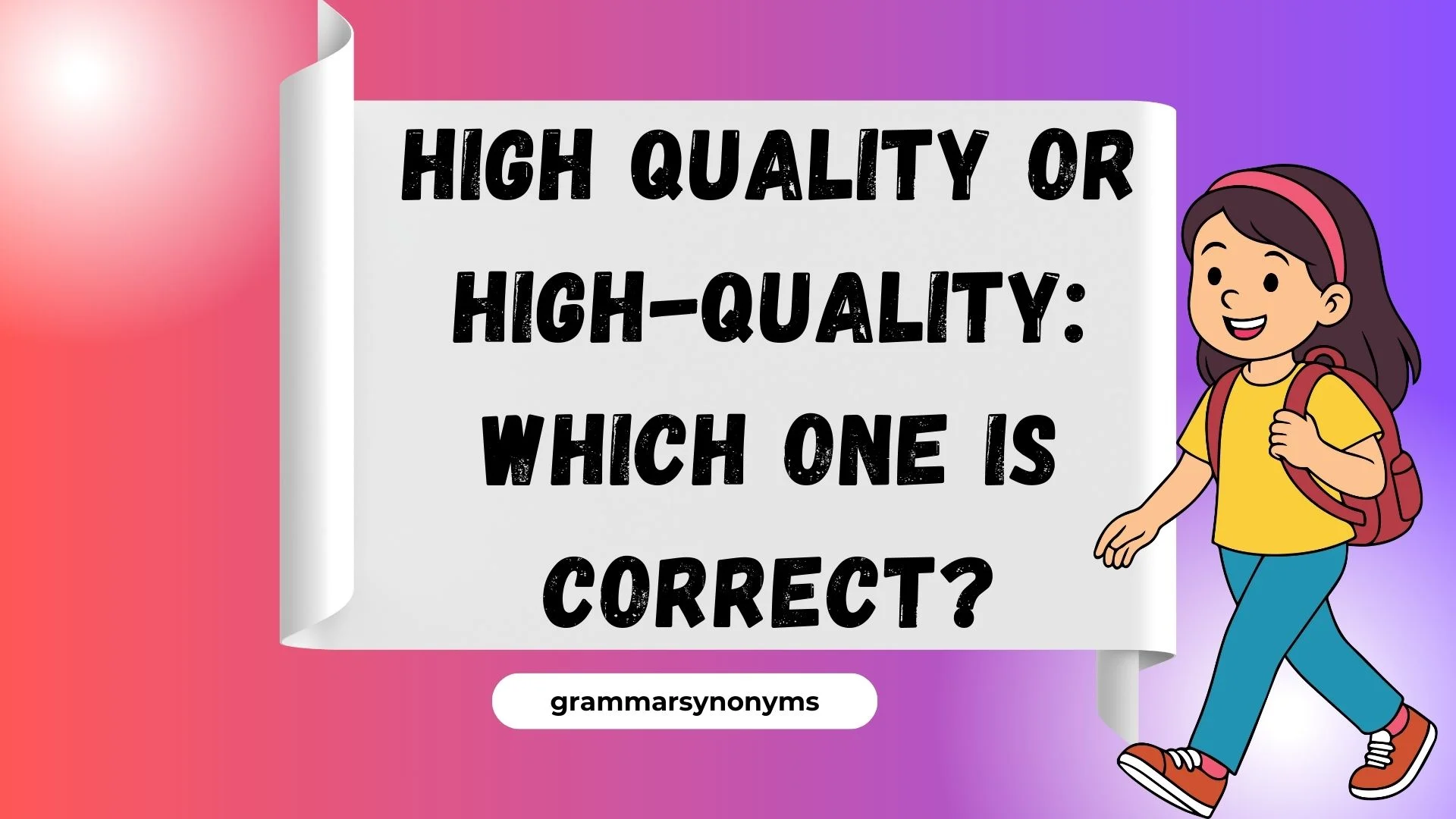
Have you ever paused mid-sentence, unsure whether to write “high quality” or “high-quality” in your emails, reports, or project plans?
It’s a small detail, but in business communication, formal writing, or even when managing online bookings, meetings, and calendar schedules, choosing the correct form matters. Using a hyphen incorrectly can affect consistency, confuse readers, or make your English usage appear less professional. Whether you’re drafting a broadcasting script, updating project management documents, or writing for US vs. UK audiences, understanding the rules behind high-quality vs high quality ensures your writing remains clear and authoritative.
In this article, we’ll break down the difference between “high quality” and “high-quality”, explain when to use each, and highlight how style guides, grammar conventions, and regional preferences influence your choice. You’ll learn practical tips for maintaining consistency across emails, reports, and time management schedules, making your professional communication smoother and more polished.
By the end, you’ll confidently know which version fits your formal writing, calendar planning, and project management tasks, all while keeping your tone engaging and accurate.
So, let’s have fun exploring this subtle yet important aspect of English usage!
Understanding the Basics
Before diving into usage rules, it’s important to understand the grammar behind these terms. This helps you apply rules consistently rather than guessing.
What is an Adjective vs. Adjective Phrase?
An adjective is a word that describes a noun. For example:
- This is a high product.
A compound adjective is when two or more words work together to describe a noun. For example:
- This is a high-quality product.
Here, “high-quality” functions as one unit to describe the noun product. Without the hyphen, the meaning can become unclear. For instance:
- High quality products are essential. → This can be read as “products that are high in quality,” which is correct only after the noun.
Understanding the distinction between single adjectives and compound adjectives is key to using hyphens correctly.
What Makes a Hyphen Necessary?
A hyphen connects words to make their combined meaning clear. English often uses hyphens in compound adjectives that appear before a noun. For example:
- Well-known author
- State-of-the-art technology
- Fast-paced game
Without the hyphen, the reader may stumble or misinterpret the meaning. Compare:
- Well known author → Slightly confusing
- Well-known author → Clear, precise, professional
In the case of high-quality, the hyphen ensures readers know that “high” and “quality” act together to describe the noun.
High Quality vs. High-Quality
Now that we’ve covered the basics, let’s examine the exact difference between the two forms.
High Quality (Without Hyphen)
You use high quality without a hyphen when it comes after the noun. In this position, it functions as a predicate adjective. For example:
- The product is high quality.
- The food at this restaurant is high quality.
Here, the words are not directly modifying a noun in front of them, so the hyphen is unnecessary. It’s also perfectly natural in spoken English.
High-Quality (With Hyphen)
Use high-quality with a hyphen when it directly modifies a noun before the noun. Examples include:
- She bought a high-quality laptop.
- They provide high-quality services.
- This is a high-quality image.
Without the hyphen in these cases, the sentence might still be understood, but it can feel clunky or unclear. Hyphenation improves readability and conveys professionalism, which is essential in business, academic, or marketing writing.
Common Mistakes to Avoid
Even experienced writers make mistakes with hyphenation. Here are the most common pitfalls and how to avoid them:
| Incorrect | Correct | Explanation |
| High quality laptop | High-quality laptop | Hyphen needed before the noun |
| The food is high-quality | The food is high quality | Hyphen not needed after the noun |
| She is a well known author | She is a well-known author | Hyphen clarifies meaning before the noun |
| Fast paced game | Fast-paced game | Hyphen connects the two words modifying a noun |
Tips to avoid mistakes:
- Ask yourself: Is the adjective before or after the noun?
- Read the sentence aloud to check clarity.
- Consult style guides (Chicago, APA, or MLA) for consistency.
4. Advanced Tips and Nuances
Even if you understand the basic rules, writing professionally often requires mastering the nuances.
4.1 When to Keep or Omit the Hyphen
Some compound adjectives are flexible:
- Well known → after the noun: The author is well known.
- Well-known → before the noun: The well-known author spoke at the event.
These variations exist because English adapts to context and style preferences. Writers should prioritize clarity and readability.
Also Read This : Cacoon or Cocoon: Which Spelling is Correct? (With Examples)
Other Compound Adjectives
High-quality isn’t unique; many similar constructions exist. Here are examples:
- State-of-the-art technology
- High-speed internet
- User-friendly interface
- Eco-friendly products
- Full-time employee
All of these follow the same rule: hyphenate before the noun, omit after it.
Regional Variations
While American and British English generally follow the same rules, some hyphenations differ. For example:
- British English often prefers: high-quality always, even after the noun.
- American English favors: high quality after the noun without a hyphen.
Understanding your audience ensures your writing feels natural and authoritative.
5. Quick Tips for Writers
Here are some practical strategies to write confidently:
- Hyphenate before the noun: high-quality laptop
- Skip hyphen after the noun: The laptop is high quality.
- Check style guides for professional documents.
- Read aloud to ensure clarity.
- Avoid over-hyphenation, which can confuse readers.
- Use tables and diagrams for internal guides in your writing team.
6. Summary / Conclusion
To recap:
- Use high-quality when the adjective comes before a noun.
- Use high quality when it comes after a noun.
- Hyphens improve clarity, readability, and professionalism.
- Always consider context, audience, and style guide recommendations.
Mastering this small rule can make a huge difference in your writing, especially in professional, academic, or marketing contexts. Correct usage conveys attention to detail and builds trust with your readers.
7. Bonus: Visual Guide
Diagram: Placement of Hyphens
| Before the Noun | After the Noun |
| High-quality laptop | The laptop is high quality |
| Fast-paced game | The game is fast paced |
| State-of-the-art tech | The technology is state of the art |
This table serves as a quick reference for writers to ensure accuracy and consistency in their writing.
FAQs
1. What is the difference between “high quality” and “high-quality”?
“High-quality” with a hyphen is used as a compound adjective before a noun (e.g., “high-quality project”), while “high quality” without a hyphen usually follows the noun or stands alone (e.g., “The project is high quality”).
2. When should I use a hyphen in “high-quality”?
Use a hyphen when two words work together to modify a noun directly, ensuring clarity in formal writing, business communication, and project management documents.
3. Does US vs UK English affect “high quality” usage?
Yes. US English prefers hyphenation more often in compound adjectives, whereas UK English sometimes allows both hyphenated and unhyphenated forms depending on style guides.
4. Can I use “high quality” in emails and business communication?
Absolutely. In emails, calendar schedules, online booking, or broadcasting notes, choose the form based on whether it precedes or follows the noun, maintaining consistency throughout your writing.
5. How do style guides recommend “high-quality”?
Most style guides like APA, Chicago, and Oxford recommend using high-quality with a hyphen when it functions as a compound adjective before a noun. For post-noun usage, “high quality” without a hyphen is acceptable.
Conclusion:
In conclusion, understanding the distinction between high quality and high-quality is more than a grammar exercise—it’s a matter of professional clarity and consistency. Whether you’re scheduling meetings, managing projects, drafting formal writing, or handling business communication, using the correct form ensures your message is clear, polished, and credible. Paying attention to style guides, regional preferences, and proper English usage reinforces your authority and prevents confusion in both written and digital communication.
By applying these simple rules, you can enhance your time management, streamline online booking and calendar planning, and maintain a professional tone across all platforms. Next time you write an email, a broadcasting note, or a project update, you’ll confidently choose the right form—making your communication not only accurate but also effective. So remember, mastering small details like this allows you to write with precision, professionalism, and ease.

“Emma Brooke at Grammar Synonyms is your trusted source for mastering the art of language. Whether you’re looking for the perfect synonym, refining your grammar, or searching for that one ideal phrase, we’ve got you covered. With a wealth of tools and resources, Emma Brooke brings you creative solutions for all your writing needs, making sure your words always hit the mark. Unlock a world of language possibilities and elevate your writing with ease.”