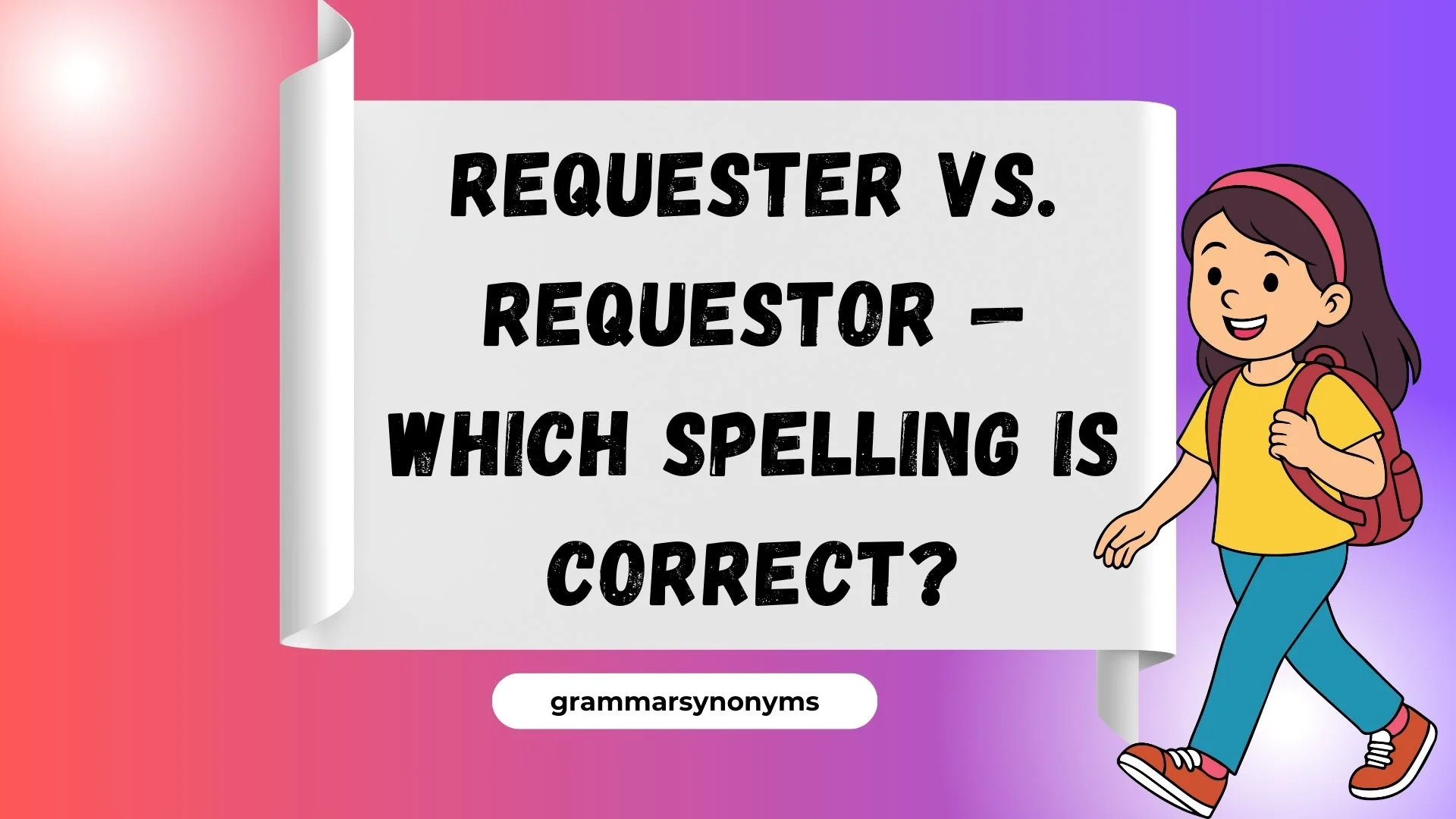
Ever paused while typing an email or scheduling a meeting and wondered whether to write requester or requestor? It’s a small detail, yet it can subtly affect your professional communication, from business emails to online booking confirmations and project management calendars. Knowing the correct spelling not only ensures consistency but also demonstrates attention to detail in formal writing, whether you follow US or UK style guides. So, before you hit send or broadcast a message, it’s worth clarifying which form fits your context.
You’ll discover how regional preferences, style guides, and practical scenarios influence which term to use, helping you write with confidence and precision. By the end, you’ll not only have fun mastering this nuance but also strengthen your professional writing skills for clear, effective communication.
Why One Letter Confuses So Many Writers
English thrives on patterns, then gleefully breaks them.
You’ve seen this movie before.
Writer or author?
Buyer or purchaser?
Driver or operator?
Now add:
Requester or requestor?
This one confuses people for three reasons:
1) English borrows too much
English steals vocabulary from everywhere: Latin, French, Norse, Greek.
Each donor brings its own rules.
-er comes from native English patterns.
-or usually comes from Latin-based formations.
That collision creates spelling twins that look equal but aren’t.
2) Legal English muddies the water
Legal writing preserves old forms the way museums preserve fossils.
When you see “requestor” in a contract, it feels official.
However, “official” does not equal “correct in modern English.”
3) Autocorrect avoids the issue
Spellcheck tools often don’t flag requestor.
That silence makes writers assume both forms work.
They don’t.
One spelling has won.
The other just refuses to leave.
Quick Answer (For Skimmers)
Let’s cut straight through the noise.
The outdated and rarely used variant is REQUESTOR
Here’s the truth in one glance:
| Word | Correct | Modern Use | Recommendation |
| Requester | Yes | Common | Always use |
| Requestor | ⚠ Rare | Uncommon | Avoid unless quoting |
If you use one word today in professional writing, choose requester.
What Does “Requester” Actually Mean?
A requester is simply the person or party who makes a request.
Plain and powerful.
No legal mystery.
No formal fog.
Everyday examples:
- A customer who submits a support ticket = requester
- A student asking for documents = requester
- A company demanding payment info = requester
Sample sentences:
- “Each requester must verify their identity.”
- “The requester will receive confirmation within 24 hours.”
- “Only the original requester may cancel the application.”
In real systems:
You see requester used in:
- Online forms
- Account dashboards
- Help desks
- Government portals
- Email templates
- API documentation
This isn’t a stylistic trend.
It’s the dominant language of modern systems.
What Is “Requestor” And Why It Exists
Now for the ghost word.
Requestor survives mainly because older language never really dies.
It just becomes decorative.
The history behind it:
Words ending in -or often trace back to Latin:
- Creditor
- Debtor
- Grantor
- Vendor
Legal English carried these forms into the present unchanged.
Then “requestor” piggybacked along.
Where you still see it:
- Old contracts
- Court templates
- Legacy systems
- Bureaucratic documents
- Outdated manuals
But outside legal archives?
It’s barely breathing.
The reality:
“Requestor” isn’t incorrect in the dictionary sense.
However, it’s incorrect in the practical sense.
Modern English doesn’t use it.
Professionals don’t prefer it.
Editors remove it.
Linguistic Rule: Why “Requester” Wins
English plays favorites.
This is one of those cases.
The core rule:
When you take a verb and label the action-taker, English uses -er.
You ask → asker
You teach → teacher
You drive → driver
You manage → manager
You request → requester
Simple pattern.
Strong pattern.
Reliable pattern.
Why “requestor” breaks the pattern:
Words ending in -or usually:
- Come from Latin roots
- Represent status or title
- Enter English as imports
“Request” came to English as a full verb, not a title.
So English treats it as a normal action word, not a formal noun.
That’s why requester fits.
That’s why requestor sticks out.
Modern Usage and Dictionary Authority
You don’t need opinions.
You need proof.
Here’s what authoritative dictionaries show.
Recognized as standard:
- Merriam-Webster lists requester as common
- Cambridge Dictionary includes requester clearly
- Oxford Learner’s Dictionary confirms requester as standard
How dictionaries treat “requestor”:
- Labeled “less common”
- Often omitted
- Sometimes relegated to footnotes
That tells you all you need.
Language authorities follow usage.
People use requester.
So do dictionaries.
Also Read This: Since vs Sense: Understanding When to Use Each Word
Legal vs. General English — The Real Difference
Let’s deal with the elephant in the courtroom.
In legal writing:
Yes, you may still spotted requestor in:
- Court filings
- Contracts
- Regulations
- Statutes
Why?
Because legal documents rarely modernize language.
They preserve precedent.
However…
In real-world business:
Corporate lawyers today increasingly use requester.
Why?
Because clarity beats tradition.
Confused readers cause disputes.
Clear language prevents them.
In everyday communication:
If you write:
- Emails
- Policies
- Help articles
- Agreements
- Reports
- UX content
Use requester.
Every time.
A practical test:
Type both into Google.
- “Requester definition” → immediate results
- “Requestor definition” → scattered and limited
If language were a market, requester owns the stock.
Common Mistakes to Avoid
Avoid these traps:
Using both in the same document
Copying old legal text without editing
Picking “requestor” to sound formal
Trusting spellcheck blindly
Assuming both are equal
Better habits:
Pick one spelling and stick to it
Default to requester
Modernize older documents
Maintain coherence
Consistency builds trust.
Confusion kills credibility.
How to Choose the Right Spelling Instantly
Here’s your shortcut.
If it’s a person making a request, use REQUESTER.
Simple decision grid:
| Situation | Use |
| Website content | requester |
| Customer emails | requester |
| Contracts you write | requester |
| Policy manuals | requester |
| Academic work | requester |
| Quoting a law | Keep original |
If you remember one thing, remember this:
Old text stays old.
Your writing doesn’t have to.
Real-World Examples in Context
See the difference in action:
| Context | Correct |
| Web form | requester |
| App UI | requester |
| Support ticket | requester |
| CRM software | requester |
| Invoice terms | requester |
| Quoted statute | depends |
Compare the tone:
“The requestor must submit documentation.”
“The requester must submit documentation.”
The second sounds:
- Clear
- Modern
- Professional
The first sounds… antique.
Final Verdict
Let’s end the debate cleanly.
Requester is correct.
Requestor is legacy.
One lives in modern English.
The other lives in document museums.
If you want your writing to:
- Sound natural
- Build trust
- Avoid confusion
- Pass editorial review
Choose REQUESTER.
English didn’t vote publicly.
It voted with usage.
Requester won.
FAQs
Is “requestor” grammatically incorrect?
No, but it is practically obsolete.
Can I use both interchangeably?
Not if you care about consistency or credibility.
Why do legal documents still show “requestor”?
Because legal language updates slowly.
Will using requestor confuse readers?
Yes. It signals outdated writing.
Which should appear in contracts?
Modern contracts prefer requester.
Conclusion:
Understanding the difference between requester and requestor may seem minor, but it plays a crucial role in professional communication, formal writing, and even project management. By considering regional preferences, style guides, and practical contexts like scheduling, meetings, and online bookings, you can ensure your writing is clear, consistent, and authoritative.
Next time you draft an email, prepare a calendar invitation, or broadcast a message, you’ll know which term fits perfectly. Embracing these small but meaningful details not only sharpens your grammar skills but also boosts your credibility in any business or formal setting. And most importantly, you can have fun mastering the subtle nuances of English usage while communicating with confidence.

“Emma Brooke at Grammar Synonyms is your trusted source for mastering the art of language. Whether you’re looking for the perfect synonym, refining your grammar, or searching for that one ideal phrase, we’ve got you covered. With a wealth of tools and resources, Emma Brooke brings you creative solutions for all your writing needs, making sure your words always hit the mark. Unlock a world of language possibilities and elevate your writing with ease.”