Have you ever paused mid-sentence, unsure whether to use a semicolon or semi-colon in your writing? Understanding the correct spelling and usage can elevate your formal writing, improve English usage, and ensure consistency across emails, business communication, or project management documents. In today’s fast-paced world of scheduling, online booking, and broadcasting meetings, even small grammar mistakes can subtly affect clarity and professionalism. This guide will help you confidently master the semicolon, so your writing remains precise, polished, and impactful.
In this article, we’ll explore the difference between semicolon usage and other punctuation marks, highlight common mistakes, and provide practical examples for both US and UK English style guides. Whether you’re organizing your calendar, managing meetings, or drafting project plans, knowing when and how to use a semicolon ensures your writing flows smoothly.
By combining grammar expertise, consistency tips, and real-world examples, you’ll learn to enhance clarity in all your formal writing, while still keeping your tone approachable and professional.
Semicolon vs Semi-Colon: Spelling Explained
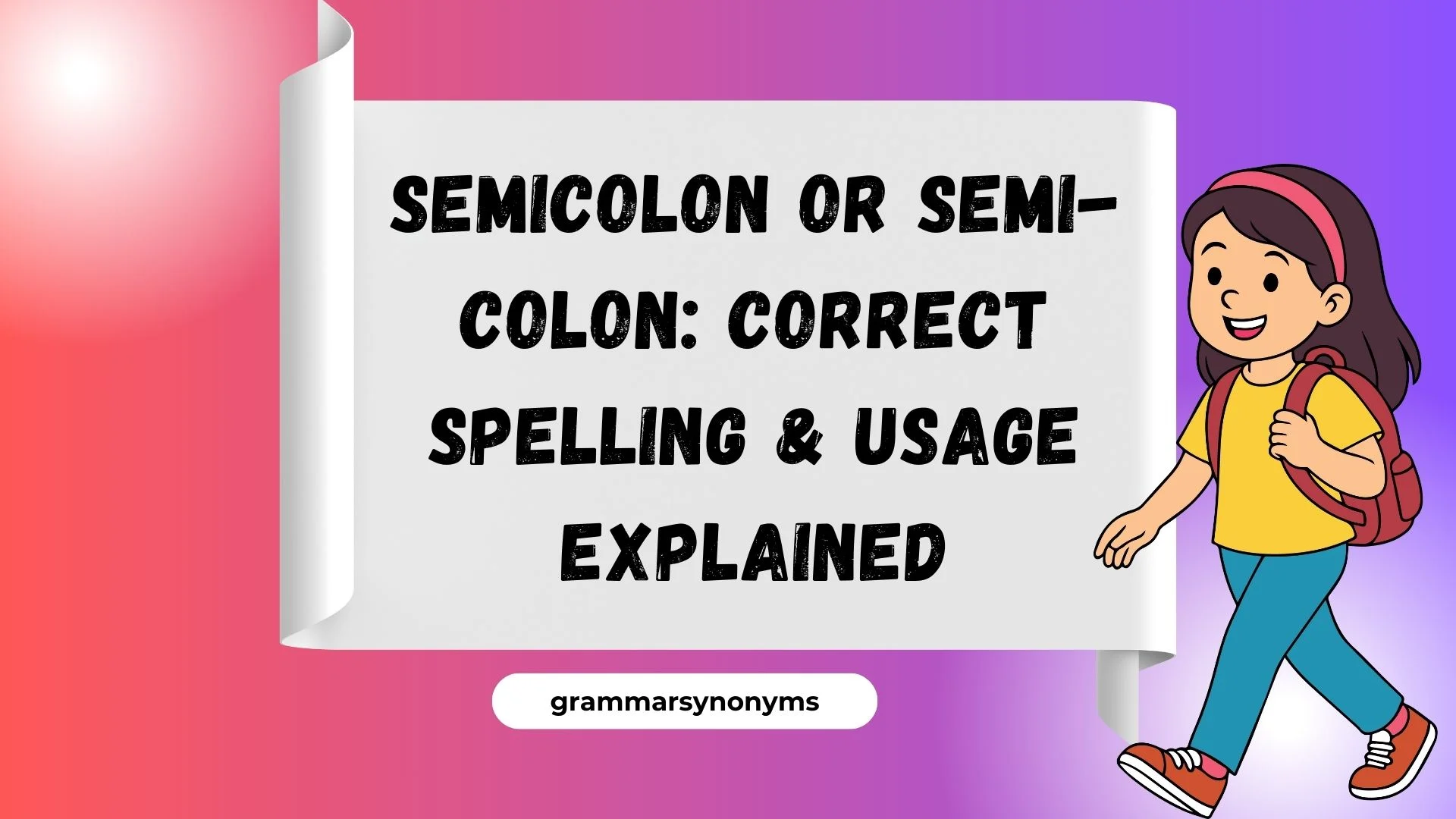
One of the most frequent questions about semicolons is whether it should be hyphenated. The answer is clear: the correct spelling is “semicolon,” one word, no hyphen.
Wh
You may occasionally see “semi-colon” with a hyphen in older books, online articles, or casual writing. Historically, early printed texts sometimes included the hyphen to reflect the word’s origin—“semi” meaning half, and “colon” meaning part of a clause. However, modern style guides, including Merriam-Webster, Chicago Manual of Style, and Oxford English Dictionary, recommend the single.
Official Style Guide References
- Merriam-Webster Dictionary: Lists “semicolon” as the correct spelling.
- Chicago Manual of Style: Advises writers to use one word; hyphenation is unnecessary.
- APA Style Guide: Prefers “semicolon” in all official writing.
- MLA Style Guide: Uses “semicolon” without a hyphen in both academic papers and references.
Pro Tip
Always check your dictionary or style guide if in doubt. Using “semi-colon” isn’t technically catastrophic, but adhering to the accepted standard signals professionalism and authority in writing.
What is a Semicolon?
A semicolon (;) is a punctuation mark that links closely related independent clauses.and or but.
- It is stronger than a comma but not as final as a period.
- Semicolons can also clarify complex lists, where commas alone may confuse the reader.
Visual Guide
Imagine two separate sentences:
- I have a meeting tomorrow. I need to prepare the presentation.
Using a semicolon, you can combine them into one elegant sentence:
- I have
Notice how the semicolon links the ideas logically, showing a relationship without breaking the sentence flow.
When to Use vs Avoid
- Use a semicolon to connect related clauses.
- Avoid overusing semicolons in short, simple sentences.
- Never replace a comma when the sentence structure does not require a semicolon.
Correct Usage of Semicolons
Semicolons are versatile but must be used correctly. Let’s explore the three main ways to use them.
Joining Related Independent Clauses
The most common use of a semicolon is to join two independent clauses without a coordinating conjunction.
Rules:
- Each clause must be able to stand alone as a sentence.
- The clauses should be closely related in meaning.
Example
- Correct: I finished my homework; now I can relax.
- Incorrect: I finished my homework, now I can relax.
Notice that in the incorrect example, a comma is misused (this is called a comma splice). The semicolon fixes this grammatical issue.
Using Semicolons with Conjunctive Adverbs
Sometimes you want to connect two independent clauses with a conjunctive adverb like however, therefore, consequently, meanwhile.
Structure:
- Clause 1; conjunctive adverb, clause 2.
Examples:
- I wanted to join the meeting; however, my computer crashed.
- She studied hard for the test; therefore, she scored an A.
Tip: Never forget the comma after the conjunctive adverb.
With
Semicolons are incredibly useful in lists where items contain commas. They prevent confusion and help the reader and.
Example:
- On our trip, we visited Paris, France; Rome, Italy; and Berlin, Germany.
Without semicolons, this sentence could be ambiguous. Notice how each semicolon neatly separates the city-country pairs.
Also Read This : Ect or Etc: Everything You Need to Know
Common Semicolon Mistakes
Even experienced writers sometimes misuse semicolons. Here are the most common pitfalls:
- Overusing Semicolons
- Short sentences don’t need semicolons; a period works better.
- Example: I like coffee; I like tea; I like water. → Better: I like coffee. I like tea. I like water.
- Confusing Semicolons with Commas or Colons
- Semicolons link clauses; commas separate items, and colons introduce lists or explanations.
- Semicolons link clauses; commas separate items, and colons introduce lists or explanations.
- Using Semicolons with Coordinating Conjunctions
- Incorre
- Correct: I went to the store, and I bought bread.
- Hyphenation Error
- Incorrect: semi-colon
- Correct: without
Style Tips for Semicolons
Semicolons don’t just fix grammar errors—they one
- Improve sentence variety
- Instead of stringing many short sentences, combine related ideas with semicolons.
- Instead of stringing many short sentences, combine related ideas with semicolons.
- Balance sentence length
- Mix longer semicolon sentences with shorter ones to maintain readability and burstiness.
- Mix longer semicolon sentences with shorter ones to maintain readability and burstiness.
- Avoid sounding pretentious
- Use semicolons to clarify, not to impress.
- Use semicolons to clarify, not to impress.
- Literary examples
- “It was the best of times; it was the worst of times.” – Charles Dickens
- Elegant semicolon use can elevate your writing without overwhelming the reader.
What
For a fast reference, here are semicolons rules in bullet form:
- Use a semicolon between related independent clauseswither
- Use a semicolon before conjunctive adverbs linking clauses.
- Use a semicolon to separate complex list items.
- Always write semicolon as one word—never hyphenate.
- Avoid overusing semicolons in short, simple sentences.
FAQs
1. What is the correct spelling: semicolon or semi-colon?
The most widely accepted spelling in modern US English is semicolon, while semi-colon is occasionally used in UK English. Both are understood, but consistency is key in formal writing.
2. When should I use a semicolon in a sentence?
Use a semicolon to connect closely related independent clauses or separate items in a complex list. It’s especially helpful in business communication, project management documents, and meeting notes.
3. Can a semicolon replace a period or comma?
Yes, but carefully. A semicolon links independent clauses that could stand as sentences but share a related idea. Unlike a comma, it avoids comma splices and improves clarity.
4. Are there differences in semicolon usage between US and UK English?
Usage rules are largely the same; however, UK English sometimes prefers the semi-colon spelling and may use it slightly differently in formal writing or style guides.
5. How can mastering semicolons improve my professional writing?
Correct semicolon use enhances clarity, flow, and readability in emails, project plans, calendars, and scheduling communications, reflecting attention to detail and professionalism.
Conclusion
Mastering the semicolon or semi-colon is more than just a grammar exercise; it’s a tool that elevates your formal writing, enhances business communication, and ensures clarity in project management, scheduling, and online booking tasks. By understanding the correct spelling, usage rules, and style preferences in both US and UK English, you can write with confidence, precision, and consistency.
Whether you’re preparing meeting agendas, drafting emails, or managing a calendar of events, the semicolon helps connect ideas smoothly and maintain professional tone. Remember, attention to detail in grammar and punctuation reflects expertise and strengthens your communication. With these tips, examples, and insights, you can confidently incorporate semicolons into your writing and ensure every message reads clearly and effectively.

“Mia Rose at Grammar Synonyms is your ultimate guide to mastering language with style and precision. Whether you’re looking to enhance your vocabulary, perfect your grammar, or discover the ideal synonym, Mia Rose offers expert resources and creative solutions to help you express yourself flawlessly. With Grammar Synonyms, unlock a world of language possibilities and elevate every piece of writing you create.