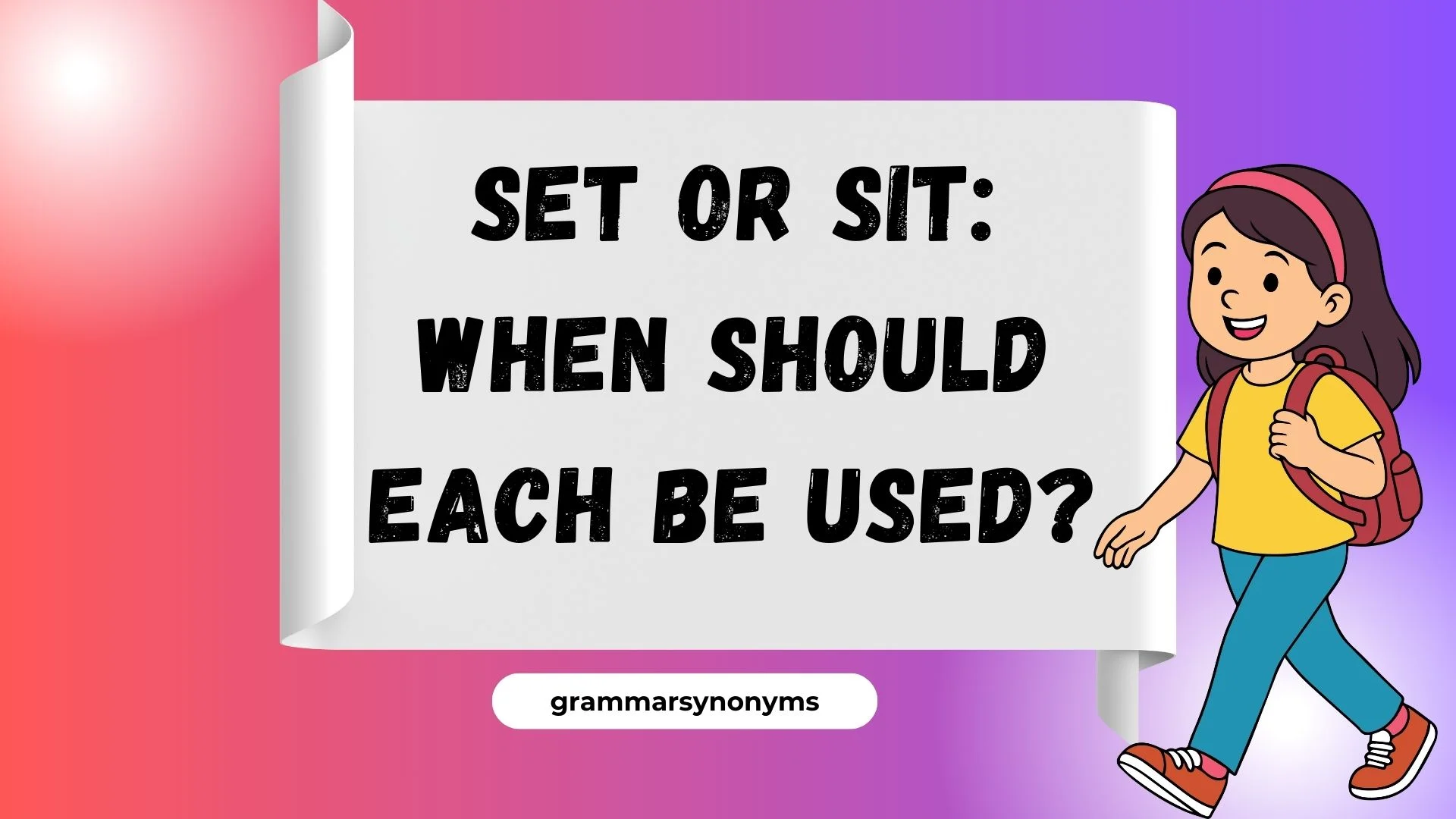
Have you ever paused mid-sentence, unsure whether to use “set” or “sit” in your writing? Whether you’re managing a calendar, scheduling meetings, or drafting formal business communication, confusing these verbs can disrupt clarity. Learning the difference not only improves English usage but also ensures consistency in project management, broadcasting, and online booking contexts. So, while you organize your day or schedule tasks, remember it’s possible to have fun mastering grammar rules without stress.
In this article, we’ll explore when to use “set” versus “sit”, highlighting practical examples in formal writing, business emails, and everyday conversation. You’ll discover tips that align with both US and UK style guides, improving your time management, enhancing professional communication, and boosting confidence in English grammar.
By the end, you’ll know exactly how to use these verbs correctly—so you can write with precision and still have fun while doing it.
Understanding the Basics – Set vs Sit
Before we go deep, it’s essential to grasp the core meanings of these words. They may seem interchangeable at first glance, but their functions in a sentence are completely different. Understanding this distinction is the key to avoiding mistakes.
What “Set” Means
Set is a verb that means to place or put something somewhere intentionally. The most important rule to remember is that set always requires a direct object—you can’t “set” without placing something.
Examples:
- Correct: I set the book on the table.
- Incorrect: I set on the table.
Notice that in the correct example, there is a direct object (the book). This is the defining feature of “set.”
Common phrases using set:
- Set the table – I need to set the table before dinner.
- Set a timer – She set a timer for 20 minutes.
- Set a goal – He set a goal to run five miles daily.
Tip: If you can replace your word with “place” or “put,” you probably need set.
What “Sit” Means
Sit, on the other hand, means to rest in a seated position. The key difference is that sit does not take a direct object. You can sit yourself down, but you don’t sit something else.
Examples:
- Correct: I sit on the chair every morning.
- Incorrect: I sit the chair every morning
Common phrases using sit:
- Sit down – Please sit down and relax.
- Sit back – He sat back in his chair after a long day.
- Sit tight – Sit tight while we finish setting up the stage.
Tip: If it’s about your own action of being seated, you are almost always using sit.
Detailed Rules and Usage
Now that you understand the basics, let’s break down when exactly to use set and sit, along with some common phrases and tables for easier comprehension.
When to Use “Set”
- There is an object being placed.
- Example: She set the vase on the shelf.
- It refers to intentional placement.
- Example: He carefully set the cup down to avoid spilling.
Common phrases with set:
- Set the table
- Set a timer
- Set a goal
- Set the scene
Table: Similar verbs to “set”
| Verb | Meaning | Example |
| Place | To put something somewhere | Place the book on the shelf. |
| Put | General act of putting something | Put your keys on the counter. |
| Arrange | Organize something carefully | Arrange the flowers in a vase. |
When to Use “Sit”
- Refers to your own action of being seated.
- Example: I sit by the window every morning.
- Example: I sit by the window every morning.
- Can describe temporary positioning without moving an object.
- Example: Sit quietly until the teacher arrives.
- Example: Sit quietly until the teacher arrives.
Common phrases with sit:
- Sit down
- Sit back
- Sit tight
Table: Similar verbs to “sit”
| Verb | Meaning | Example |
| Perch | Sit lightly or on the edge | She perched on the stool. |
| Rest | Relax in a seated position | He rested on the bench. |
| Lounge | Sit or lie in a relaxed way | They lounged on the sofa. |
Common Mistakes and How to Avoid Them
Mistakes with set and sit usually happen because of confusing transitive and intransitive verbs. Let’s look at examples and corrections:
| Incorrect | Correct | Explanation |
| I set on the chair. | I sit on the chair. | “Set” needs an object. |
| Please sit the book on the table. | Please set the book on the table. | “Sit” cannot take an object. |
| I set down for a break. | I sit down for a break. | You are taking a seat, not placing something. |
Tip: Ask yourself, Am I placing something, or am I just taking a seat? If it’s the former, set is the right choice.
Easy Memory Tricks
Sometimes, you need a quick way to remember the difference between set and sit. Here are some tricks:
- Set = Something is sEt down → Think of “sEt” as placing an object.
- Sit = You Sit → Focus on your own position.
- Mnemonics:
- Set = I sEt the object.
- Sit = I sIt myself.
Mini Exercise: Identify whether each blank requires set or sit:
- Please ___ the vase on the table.
- I will ___ by the window.
- She ___ the keys on the counter.
- We should ___ quietly until the show starts.
Answers: 1-set, 2-sit, 3-set, 4-sit
Advanced Usage and Exceptions
English has a few twists when it comes to these verbs:
Past Tense Forms
- Sit → sat → Yesterday, I sat by the fire.
- Set → set → She set the glass down carefully.
Confusing Idioms
- Set in stone – Something fixed or unchangeable.
- Sit tight – Wait patiently.
- Set up – Arrange or prepare something.
- Sit out – Skip participation.
Regional Differences / Informal Usage
- In some informal English contexts, “sit” may appear with objects, but it is not grammatically standard. Always stick to the rules above for formal and clear writing.
Also Read This : Agreeance vs Agreement: Which One to Use?
Practice Exercises
Let’s put your knowledge into action with practical exercises:
Fill-in-the-Blank Sentences
- I ___ my backpack on the chair.
- He ___ quietly in the corner during class.
- Please ___ the plates on the table.
- We will ___ and watch the movie.
Identify the Mistakes
- She sit the book on the desk.
- I set on the sofa after work.
- They sat the vase on the table.
Answers:
- 1 → set the book
- 2 → sit on the sofa
- 3 → set the vase
Faqs:
1. What is the main difference between “set” and “sit”?
“Set” usually requires a direct object (e.g., “Set the book on the table”), while “sit” is intransitive and doesn’t take an object (e.g., “Sit on the chair”). Understanding this difference improves English usage in both formal and informal contexts.
2. Can “sit” ever be used transitively like “set”?
No, “sit” is always intransitive, meaning it describes the action of placing oneself or an object without acting on something else. Using it incorrectly can confuse readers in business communication or project management documents.
3. Is there a difference in usage between US and UK English?
The rules for “set” and “sit” are generally the same in US and UK English, but minor style preferences may vary in formal writing or publications. Following style guides ensures proper usage across regions.
4. How can I remember when to use “set” or “sit”?
A simple tip: if you’re placing or putting something somewhere, use set. If you’re positioning yourself or an object naturally, use sit. This works well for calendar scheduling, meetings, or everyday communication.
5. Why is it important to get “set” and “sit” right?
Correct usage enhances clarity, professionalism, and consistency in writing. Whether in emails, broadcasting schedules, or online booking systems, knowing the difference prevents confusion and strengthens grammar skills.
Conclusion
Mastering the difference between “set” and “sit” is more than just a grammar lesson—it’s a step toward clearer, more professional business communication, accurate scheduling, and confident English usage. Whether you’re coordinating meetings, managing a calendar, or preparing formal writing, applying these rules ensures consistency and precision.
By understanding the proper contexts for each verb, you can avoid common mistakes, improve your project management efficiency, and even make online booking or broadcasting communications smoother.

“Emma Brooke at Grammar Synonyms is your trusted source for mastering the art of language. Whether you’re looking for the perfect synonym, refining your grammar, or searching for that one ideal phrase, we’ve got you covered. With a wealth of tools and resources, Emma Brooke brings you creative solutions for all your writing needs, making sure your words always hit the mark. Unlock a world of language possibilities and elevate your writing with ease.”