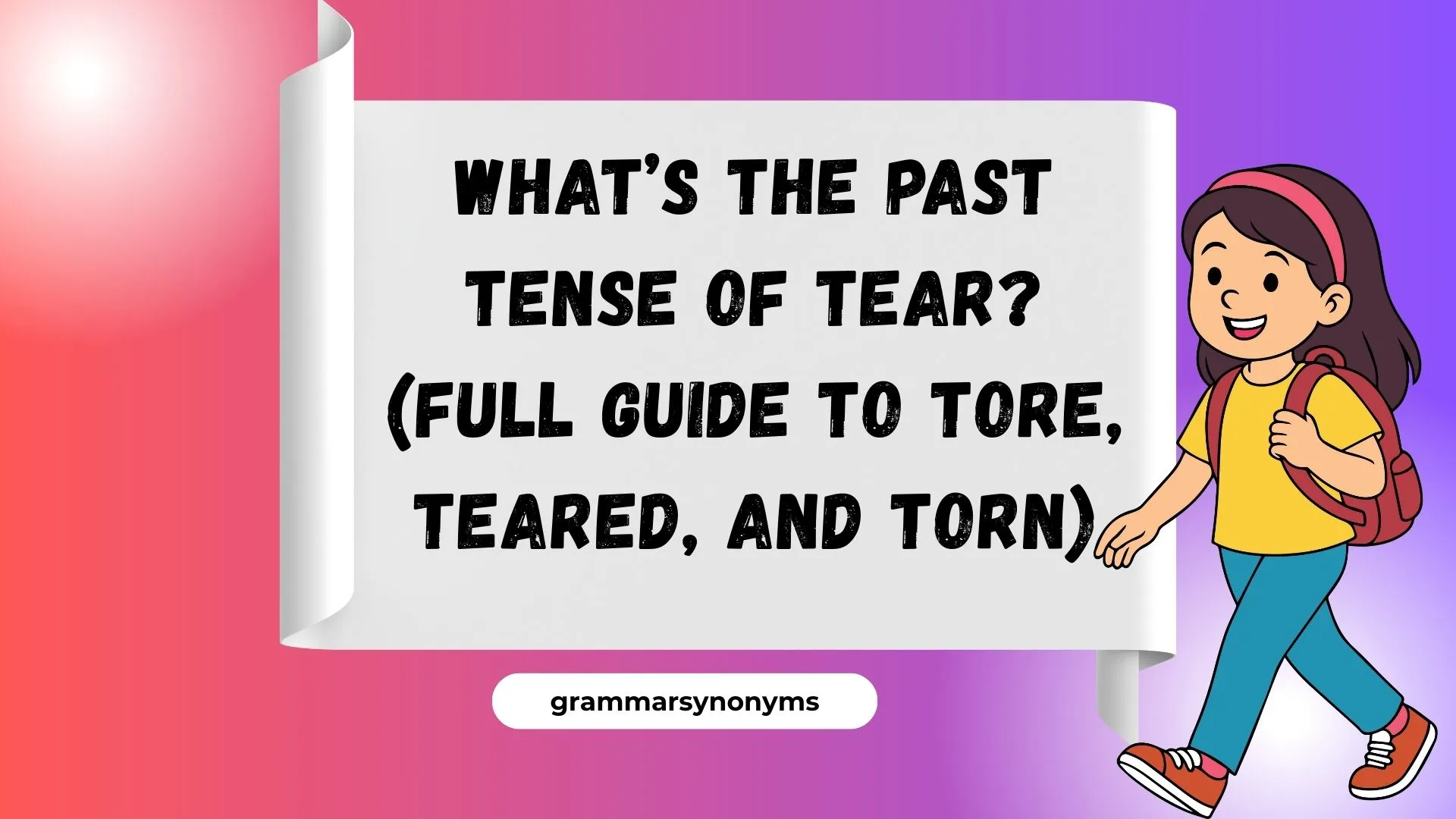
Have you ever paused mid-sentence wondering, “What’s the past tense of tear?” Whether you’re scheduling a meeting, managing your calendar, or drafting a formal email for business communication, knowing the correct usage can save embarrassment and maintain your professional credibility. English learners and native speakers alike often stumble between tore, teared, and torn, especially when writing in formal contexts or following style guides that distinguish between US and UK English. Understanding these differences not only improves your grammar and consistency, but also ensures your project management updates, online booking notes, or broadcasting scripts are polished and precise.
In this full guide, we’ll break down each form—tore, teared, and torn—and explain exactly when and how to use them. You’ll gain clarity on English usage, formal writing, and practical examples in real-world contexts, from meetings and emails to casual conversations. By the end, you’ll feel confident in your choices and even have fun while mastering a tricky part of grammar. Whether for time management documents, professional communication, or daily writing, this guide gives you the tools to stay accurate, consistent, and engaging.
Understanding “Tear” — Meaning and Pronunciation Differences
The verb tear has one spelling but two distinct meanings, and each meaning carries its own pronunciation. That single fact causes most of the confusion.
1. Tear (to rip or pull apart)
- Pronounced like tair
- Meaning: to rip, split, or pull apart with force
- Examples:
- “Kids sometimes tear their homework by accident.”
- “Don’t tear the wrapping paper yet.”
2. Tear (to cry)
- Pronounced like teer (rhymes with “ear”)
- Meaning: to produce tears from the eyes due to emotion
- Examples:
- “People often tear up during emotional scenes.”
- “A sad movie can make anyone tear.”
Both words share identical spelling but not identical grammar.
The rip version uses tore and torn as its official past forms.
The cry version uses teared only in the phrase teared up.
The next sections separate these meanings carefully so that you always choose the right form.
Past Tense of Tear (To Rip): The Correct Form Is Tore
When tear refers to ripping, the only correct simple past form is tore.
This is the rule followed in standard English across formal writing, academic contexts, literature, and everyday speech.
Why “tore” is correct
English irregular verbs often change their vowels in the past tense.
Think of these examples:
| Base Form | Past Tense |
| speak | spoke |
| write | wrote |
| drive | drove |
Tear → tore fits into this same vowel-shift pattern.
Examples
- “She tore the paper into small pieces.”
- “The wind tore the sign off the wall.”
- “They tore the old carpet out last night.”
These sentences describe past actions with no helper verbs, so tore is the only correct choice.
Past Participle of Tear (To Rip): The Correct Form Is Torn
The past participle of tear is torn, and it works with helping verbs like has, have, and had.
Examples
- “He has torn several pages out of his notebook.”
- “The fabric had already been torn before the show started.”
- “They have torn down the old building.”
Why “torn” matters
The past participle appears in:
- Perfect tenses
- Passive voice
- Adjectival forms (“a torn page”)
Mixing torn and tore is one of the most common errors English learners make.
The next table clears up the confusion:
Tear (Rip) Conjugation Table
| Form | Word | Example |
| Base Form | tear | “Please don’t tear the envelope.” |
| Simple Past | tore | “She tore it open.” |
| Past Participle | torn | “The envelope was already torn.” |
| Present Participle | tearing | “He is tearing the paper slowly.” |
Keep this table as a quick reference whenever you’re unsure.
Why Teared Is (Sometimes) Correct — But With a Different Meaning
Many people believe teared is always wrong, yet that’s not true.
The confusion clears up when you look at the emotional version of the verb.
Teared = past tense of “tear up” (to begin crying)
- “She teared up during the speech.”
- “He teared up when he saw the surprise.”
But “teared” never means “ripped”
“She teared the paper.”
“She tore the paper.”
Why this distinction exists
English sometimes forms new phrasal verbs from existing words, and tear up took on an emotional meaning that developed separately from “tear (rip).”
To make this clearer, here’s a diagram:
Conjugation Table for Tear (Both Meanings)
| Meaning | Base | Simple Past | Past Participle | Example |
| Rip | tear | tore | torn | “He tore the page.” |
| Cry | tear up | teared up | teared up | “She teared up at the ending.” |
This table shows exactly when teared works and when it doesn’t.
Common Mistakes Writers Make With Tear
Mistakes happen because this verb blends multiple challenges:
1. Using “teared” for the ripping meaning
People guess the past tense based on regular patterns, which leads to errors like:
- “The dog teared the pillow.”
The correct form is tore.
2. Mixing up tore and torn
Writers sometimes produce sentences like:
- “He has tore the book.”
It should be: - “He has torn the book.”
3. Confusing pronunciation
Students sometimes think “tear” (rip) and “tear” (cry) should share the same past forms. They don’t.
4. Overcorrecting because irregular verbs feel unpredictable
Irregular verbs form patterns, even when they hide beneath surface-level spelling.
Quick Tests to Know Whether You Need Tore or Torn
These fast checks remove nearly all confusion:
Test 1: Can you add “has,” “have,” or “had”?
If yes, use torn.
Examples:
- “She has torn her jacket.”
- “They had torn the poster already.”
Test 2: Is it a simple one-time past action?
If yes, use tore.
Examples:
- “He tore the page yesterday.”
- “The kids tore the bag open.”
Test 3: Does it involve crying?
If yes, the correct form is teared up.
Also Read This: Trailer or Trailor: Which Spelling Is Correct and Why?
Examples of “Tore” in Real Contexts
Here are practical examples showing tore in different types of writing:
Everyday Speech
- “The dog tore the cushion apart.”
- “I accidentally tore your notes.”
Storytelling
- “He tore the letter open before anyone could stop him.”
Sports Commentary
- “She tore down the field with incredible speed.”
Professional Writing
- “The construction team tore the structure down after safety concerns.”
Each example reinforces how tore stands alone in simple past situations.
Examples of “Torn” in Real Contexts
The past participle torn appears in emotional, physical, and figurative settings.
As an Adjective
- “The torn pages lay scattered on the floor.”
- “A torn flag hung from the pole.”
In Figurative Writing
- “She felt torn between loyalty and ambition.”
- “The team was torn apart by rivalry.”
In Perfect Tenses
- “He has torn the wrapping paper already.”
- “The old map had been torn long before the explorers arrived.”
Idioms and Phrases Using Tear, Tore, and Torn
English uses tear in many expressions. Here are the most common ones:
1. Tear apart
Meaning: criticize harshly or dismantle
- “The critics tore apart the performance.”
2. Tear down
Meaning: demolish or disprove
- “They’ll tear down the old stadium next year.”
3. Torn between
Meaning: unable to choose
- “He felt torn between duty and desire.”
4. Tore into
Meaning: attack verbally
- “She tore into the proposal during the meeting.”
5. Tear through
Meaning: move quickly
- “The athlete tore through the competition.”
Idioms offer lively language choices that enrich writing.
Synonyms for Tear (Rip Meaning)
These alternatives help you vary your vocabulary:
| Synonym | When to Use It |
| Rip | General tearing |
| Shred | Tear into small thin pieces |
| Split | Separate along a natural line |
| Pull apart | Tear using force |
| Break open | Open something forcefully |
Using synonyms keeps writing fresh and avoids repetition.
Frequently Confused Verbs Similar to Tear
Tear belongs to a family of irregular verbs that follow vowel-switch patterns.
Wear → wore → worn
- “She wore the jacket.”
- “The jacket is worn out.”
Bear → bore → borne
- “He bore the weight of responsibility.”
- “Traditions are borne through generations.”
These parallels help learners recognize patterns across irregular verbs.
Mini Quiz — Choose the Correct Form
Try these quick fill-in-the-blanks:
- She has ______ the envelope already.
- The dog ______ the toy apart.
- He ______ up when he saw the gift.
- The page was ______ by accident.
- They ______ down the old shed.
Answers:
- torn
- tore
- teared
- torn
- Tore
Faqs:
1. What is the correct past tense of “tear”?
The standard past tense is “tore”. For example: She tore the paper carefully. Using “teared” is generally incorrect in standard English, except when describing crying (e.g., her eyes teared up).
2. When should I use “torn” instead of “tore”?
“Torn” is the past participle, used with have, has, or had. Example: The document has been torn. It works in perfect tenses and passive constructions, unlike “tore,” which is simple past.
3. Can “teared” ever be correct?
Yes, but only in the context of eyes filling with tears. For example: His eyes teared up during the speech. It is rarely used for physical tearing of objects.
4. Are there differences between US and UK English in using these forms?
Generally, “tore” and “torn” are standard in both US and UK English. The form “teared” is informal and uncommon across both regions, though regional preferences may slightly affect usage in casual speech.
5. How can knowing these forms improve professional writing?
Using the correct form ensures grammar consistency in business communication, emails, meetings, project management updates, and online booking notes. Correct usage reflects attention to detail, credibility, and professionalism.
Conclusion:
Mastering the past tense of tear—whether tore, teared, or torn—is more than just a grammar exercise. It strengthens your English usage, ensures consistency in formal writing, and enhances clarity in business communication, project management, and time-sensitive scheduling. By understanding the subtle differences and applying them in emails, meetings, or broadcasting notes, you not only write accurately but also project professionalism and authority.
Remember, language is a tool, and using it correctly can make even complex tasks like online booking, calendar management, or team updates smoother and more efficient. With practice, choosing the right form will become second nature—and you might even have fun while doing it. Stay mindful of style guides and regional preferences, and your writing will remain polished, precise, and effective across all contexts.

“Emma Brooke at Grammar Synonyms is your trusted source for mastering the art of language. Whether you’re looking for the perfect synonym, refining your grammar, or searching for that one ideal phrase, we’ve got you covered. With a wealth of tools and resources, Emma Brooke brings you creative solutions for all your writing needs, making sure your words always hit the mark. Unlock a world of language possibilities and elevate your writing with ease.”